

How Lenders Are Using Bank Statement Analyzer to Improve Credit Decisions
ByAnjali Jain

Table of contents
In today's competitive lending landscape, speed and accuracy aren't just advantages but become necessities. Traditional loan approval processes, weighed down by manual data entry and outdated verification methods, can no longer meet the expectations of modern borrowers or the operational demands of financial institutions.
Imagine this: A small business owner walks into your bank, needing a loan to expand their shop. They have bank statements from three different accounts, pay slips, and GST documents. Your loan officer now faces hours of manual work, scrolling through transactions, hunting for salary credits, counting bounced cheques, and calculating average monthly income on Excel sheets. By the time your team finishes the bank statement analysis, the borrower has already approached two other lenders. You've lost the deal, not because of better rates, but because you were too slow. This is where a Bank Statement Analyzer plays a critical role by enabling faster, more reliable, and data-driven credit assessments.
The Evolution from Manual to Automated Bank Statement Analysis
For years, loan officers spent countless hours manually reviewing borrower transaction histories, using Excel spreadsheets to validate deposits, income patterns, and repayment behavior. These legacy processes created significant operational bottlenecks, delaying loan approvals and eroding borrower trust.
The biggest challenge was extracting and interpreting data from unstructured formats- PDFs, images, or scanned documents, which are difficult to process at scale. Manual dependency increased turnaround time and limited lenders’ ability to make quick, informed decisions. An automated bank statement analyser addresses these challenges by converting unstructured documents into usable financial data.
What Is a Bank Statement Analyzer?
A Bank Statement Analyzer is an intelligent, AI-driven platform that automatically processes bank statements submitted by loan applicants. It securely extracts transactional data from PDFs, scanned documents, and digital files, converting unstructured information into accurate, actionable financial insights. The system categorizes transactions into income, expenses, savings, and liabilities, enabling lenders to gain a clear and complete view of an applicant’s financial behavior and repayment capacity.
Key Financial & Behavioral Insights
- Behaviour & Repayment Score
- Statement Tampering Detection
- Occupation & Income Profiling
- Income Consistency Analysis
- Cash Flow Stability & Trends
- Spending Pattern Intelligence
- Debt & Liability Assessment
- Overdraft & Irregular Transaction Monitoring
- Overall Statement Health Score
This structured data enables automated financial underwriting, income verification, and risk profiling for NBFCs, fintechs, and lenders. Rather than replacing human judgment, the tool empowers credit teams with clean, consistent, and reliable financial data.
How Bank Statement Analyzers Transform Credit Decisions
1. Automation Reduces Manual Effort and Processing Time
Manual extraction from multiple statements can take hours or days. A Bank Statement Analyser automates this process within minutes by converting documents into structured datasets. This significantly reduces workload and allows lenders to process higher application volumes without compromising accuracy.
2. Enhanced Accuracy and Fraud Detection
Manual processing is prone to errors in data entry and interpretation. Automated bank statement analysis ensures data accuracy by verifying document authenticity and flagging suspicious activity such as: • Altered or doctored documents • Unusual spikes in deposits inconsistent with income patterns • Transactions that don't align with declared income sources • Duplicate entries and data mismatches Early identification of red flags strengthens risk management and prevents potential losses.
3. Real-Time Decision Making
By using AI bank statement analysis, lenders gain access to structured data in real time. This enables faster credit scoring and automated approvals based on predefined lending criteria. Some advanced analyzers even integrate directly with loan origination systems (LOS) and credit scoring engines to offer automated pre-approvals or instant decisions.
4. Deeper Financial Insights Beyond Credit Scores
Bank statement analysis offers a detailed view of borrower behavior and financial stability. Advanced analytics help lenders understand: • Recurring income stability and employment consistency • Lifestyle spending patterns and discretionary expenses • Reliance on credit and overdraft usage • Emergency fund availability and savings discipline • Seasonal income variations for business owners This helps lenders to assess an applicant's true ability and willingness to repay, leading to better risk-adjusted lending decisions.
5. Compliance and Audit Readiness
Financial institutions operate under strict regulatory frameworks. A Bank Statement Analyzer maintains a transparent digital trail of all data analysis steps, supporting in compliance with KYC (Know Your Customer), AML (Anti-Money Laundering), RBI guidelines, and other regulatory frameworks. Standardized reports can be easily stored and retrieved for audits, ensuring accountability, data governance, and full transparency in decision-making processes.
How Automated Bank Statement Analyzer Works
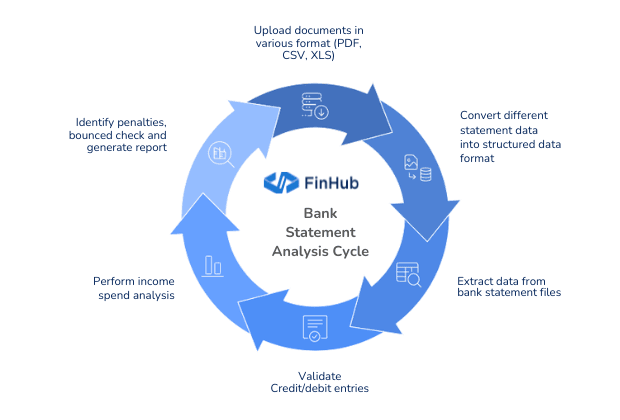
Modern bank statement analysis follows a streamlined workflow:
1. Data Ingestion - Applicants upload bank statements in PDF, scanned, or digital formats. Data can also be received through API integrations.
2. Data Extraction - The system parses unstructured documents and extracts transaction-level data using advanced recognition engines.
3. Data Structuring - Extracted information is converted into standardized, tabular formats for easy processing and analysis.
4. Data Analysis - Advanced algorithms detect behavioral patterns, income irregularities, spending habits, EMI obligations, and potential red flags.
5. System Integration - Results can be integrated with loan origination systems and underwriting platforms for further evaluation.
This workflow enables lenders to move from document submission to actionable data in minutes.
Real-World Applications of Bank Statement Analyzer Across Lending Segments
Bank statement analysers deliver value across diverse lending scenarios:
SME and Business Lending: For businesses without audited financials, bank statement analysis helps validate revenue streams, assess cash flows, and understand operational stability.
Personal and Retail Loans: Lenders use analyzers for automated income verification, evaluating spending behavior, and assessing repayment discipline before approving personal loans, consumer loans, or credit cards.
Mortgage Lending: Analyzes long-term balance trends and repayment behavior for home loans.
Compliance and Audit Automation: Built-in logging ensures complete transparency for regulators, supporting audit-readiness and accurate documentation of all credit decisions.
In fintech and neo-banking platforms, AI bank statement analysis has become a core component of customer onboarding and instant loan eligibility assessments.
Core Benefits of Bank Statement Analyzers
Speed and Efficiency: Reduce average turnaround time for credit evaluation from days to minutes, enabling faster loan approvals and improved borrower satisfaction.
Enhanced Risk Controls: Automatically flag irregular deposits, bounced payments, unusual transactions, and data inconsistencies, improving risk assessment and ensuring compliance.
Improved Credit Quality: Leverage insights from financial data to enable more accurate borrower segmentation and informed credit decisions.
Scalability and Adaptability: These platforms scale seamlessly with business growth without requiring proportional increases in operational staff.
AI-Driven Fraud Prevention: Detects manipulated statements, unverified income sources, and suspicious patterns, protecting lenders from financial losses.
Cost Reduction: Automation reduces operational costs associated with manual underwriting, data entry, and error correction, improving overall profitability.
Empowering Lenders with Data, Not Replacing Them
While automation speeds up data processing, strong credit decisions still depend on human judgment. Bank Statement Analysers support underwriters by providing clean, reliable, and well-structured financial data. By eliminating manual data extraction, these tools free up time for credit teams to focus on deeper evaluation, special cases, and borrower-specific risks. This human-in-the-loop approach ensures decisions remain fair, responsible, and compliant.
The Future of Lending in India
As India’s lending ecosystem continues to digitize, automated document processing and data extraction will become foundational components of credit infrastructure. With evolving RBI regulations and global data privacy standards, transparency and security are critical. Advanced platforms with end-to-end encryption, access controls, and comprehensive audit trails help lenders meet regulatory expectations while safeguarding borrower trust and institutional credibility.
Conclusion
In today’s fast-moving lending environment, Bank Statement Analyzers have become essential tools for modern credit operations. They automate document processing, improve accuracy, accelerate underwriting, and strengthen risk management. More importantly, they empower credit professionals with data-backed insights that enhance expertise and confidence. Instead of replacing human expertise, these platforms strengthen it by providing a solid, data-backed foundation for every decision.
For banks, NBFCs, and fintech platforms seeking faster growth and stronger risk management, adopting a robust Bank Statement Analyzer is a strategic necessity.
Ready to Transform Your Credit Decisioning Process?
Discover how FinHub’s Bank Statement Analyzer helps you extract reliable financial data, streamline income verification, and enable smarter, faster, and more confident lending decisions.