


Table of contents
Indian NBFCs are at a crossroads. Competition is rising and regulations are getting tighter. Customers also expect fast and digital experiences. NBFCs must rethink how they onboard, underwrite, and serve customers in the digital world. Financial APIs have emerged as the quiet engine behind this shift. It turns traditional NBFCs into agile, ecosystem-ready lenders that can launch new journeys in weeks instead of years.
Understanding what a financial API is and its role in this transformation is critical for NBFCs looking to lead rather than follow. Platforms like FinHub make this shift simple. It offers plug-and-play ways to modernize verification and onboarding without rebuilding their tech stack from scratch.
What Are APIs and Why Are They Crucial in Fintech?
What is an API?
Imagine you’re in a restaurant. You tell the waiter what you want, the waiter takes your order to the kitchen and then brings your food back to you. An API works the same way; it carries requests between systems and returns the response. APIs enable software systems to communicate seamlessly. These behind-the-scenes interactions power countless modern conveniences.
Why Can’t NBFCs Ignore APIs Anymore?
For most NBFCs, the legacy tech story looks similar:
- Fragmented systems,
- Multiple point solutions,
- Heavy manual work in the middle.
Loan origination, KYC, underwriting, and disbursement often run on separate systems that don’t communicate well with each other. Any change to one journey means long integration cycles, vendor coordination, and high risk of breaking something else.
Meanwhile, customers expect instant, mobile-first credit. Retail borrowers and MSMEs want fast approvals and real-time access to funds. Regulators are also demanding stronger KYC, AML checks, and tighter data security. That adds even more steps to an already complex process.
Without APIs, every new check or partner integration turns into a full transformation project.
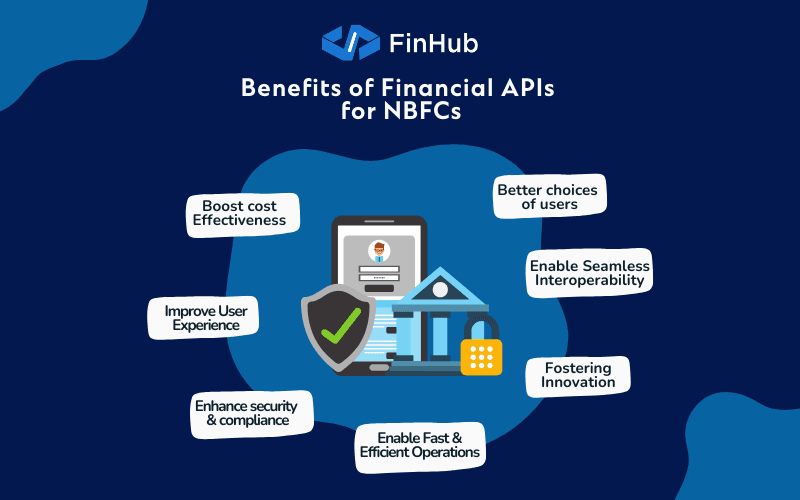
Fintech APIs flip this equation. APIs in finance allow NBFCs to:
- Operate with real-time data and instant verification
- Integrate new fintech partners quickly
- Automate manual processes to reduce turnaround times
- Adhere to regulatory requirements efficiently
How Financial APIs Transform the NBFC Value Chain
APIs are not just a technology choice; they reshape how an NBFC operates end-to-end. The impact shows clearly across the lending lifecycle.
- Frictionless Digital Onboarding and eKYC
APIs in financial services enable instant validation of identity documents. For example:- Aadhaar and PAN, along with facial recognition and liveliness checks that make onboarding quick and remote-friendly.
Video KYC adds another strong layer. AI-driven VKYC flows can guide customers through the entire process. Capturing video, verifying identity, and performing liveliness checks without a human agent. For NBFCs operating at scale or in remote regions, this improves turnaround time.
- Smarter Underwriting with Real-Time Data
Traditional underwriting depended on bureau scores and old financial records. Today, APIs in finance give access to richer, real-time data such as bank statements, GST records, and transaction history through account aggregators and connected banking. This is a big advantage for thin-file customers and MSMEs, where traditional data is weak.
When combined with decision engines, NBFCs can:
- Move from slow, batch approvals to near real-time decisions
- Improve risk accuracy
- Deliver a smoother customer experience
- Expand safely into new customer segments
- Stronger Fraud Control and Compliance
As digital lending grows, fraud is becoming more advanced. Identity spoofing, fake profiles, and multi-app fraud rings are common threats. Verification and device intelligence APIs help NBFCs spot issues early. For example- mismatched identities or unusual locations.
On the compliance side, APIs let NBFCs embed KYC, AML, and audit checks directly into customer journeys. This reduces manual work, ensures better regulatory compliance, and makes processes more traceable.
- Enabling Embedded and Ecosystem Lending
One of the biggest changes is where lending happens. With APIs, NBFCs can offer credit inside e-commerce platforms, logistics apps, OEM networks, and fintech partners. Partners handle the user experience, while NBFCs provide regulated credit behind the scenes.
_Open, well-documented APIs let NBFCs: _
- Onboard partners quickly
- Manage risk rules centrally
- Get a clear, consolidated view of performance across channels
This ecosystem approach is becoming a key growth engine for modern lenders.
Challenges and Considerations in Implementing APIs
-
Security - APIs can expose sensitive data if they are not protected well. Weak security can lead to cyberattacks and data leaks. Strong authentication, encryption, and regular audits are a must.
-
Compliance - Fintech APIs must follow strict rules like GDPR and PSD2. These laws protect user data and privacy. Meeting different global regulations is hard and needs constant updates.
-
Integration Issues - Connecting APIs to old legacy systems is tough. It may need heavy re-engineering and can cause delays or performance problems. Skilled teams and testing are essential.
-
Reliability - APIs must be stable and well-documented. Downtime or poor performance hurts user trust. Teams must monitor APIs, scale them well, and keep documentation clear.
The Future of APIs in Fintech: What Lies Ahead
-
AI and APIs - AI and APIs are working together to create smarter financial tools. AI-powered APIs can predict trends, detect fraud, and offer personalized advice by analyzing data in real time. Chatbots and virtual assistants are becoming more human-like, helping customers quickly and offering smart recommendations. This combination is making fintech faster, smarter, and more proactive.
-
Blockchain Integration - APIs connect blockchain with traditional finance. They enable crypto payments, smart contracts, and DeFi services. APIs make it easy to move money between wallets and banks, helping blockchain become part of everyday finance.
-
Hyper-Personalization - APIs give access to detailed customer insights. Fintechs can offer personalized products such as custom investment plans or real-time currency conversion. More personalization will become a major advantage in the future.
-
Global Connectivity - APIs help link financial systems across countries. They enable low-cost cross-border payments and multi-currency services. This improves access to finance, especially for underserved communities and businesses worldwide.
Meet FinHub: API Suite for Fast & Secure Lending Verification
FinHub is built for BFSI sector that want to speed up digital onboarding, verification, and compliance. It eliminates the need for complex, time-consuming integrations. It works as a single API layer for identity, verification, compliance, and fraud checks, designed.
What FinHub Delivers:
- A unified suite of verification and compliance APIs needed across lending and banking journeys. It covers KYC, AML, fraud prevention, and identity checks APIs.
- Built on an API-first, microservices architecture. It integrates easily with LOS/LMS platforms, mobile apps, core banking systems, and partner portals.
- Plug-and-play partner onboarding, enabling embedded lending and ecosystem integrations without rebuilding infrastructure.
The Key Advantage: Instead of juggling, financial institutions can use FinHub as their single verification backbone. It ensures faster launches, tighter security, and consistent customer experience across every channel.
How NBFCs Can Use FinHub in Real Life
Different NBFC can benefit from FinHub in distinct ways:
-
Digital lending NBFCs can embed FinHub’s verification APIs and Intelli VKYC into their customer apps to cut onboarding time from days to minutes, while keeping all journeys monitored through a single dashboard.
-
MSME-focused NBFCs can combine FinHub’s identity verification with external data APIs for smarter underwriting, enabling them to serve thin-file borrowers more confidently and at scale.
-
Partnership- and DSA-led NBFCs can expose FinHub-backed KYC flows to partners via standardised APIs, ensuring consistent verification of quality while retaining centralised control and auditability.
In all these cases, FinHub becomes the shared verification layer sitting between front-end journeys and core lending systems, reducing duplication and speeding up innovation.
Getting Started: From Vision to Implementation
For NBFC leaders, the strategic question is no longer “Should we adopt APIs?” but “How do we build an API-led verification and onboarding layer quickly and safely?” A practical approach is:
-
Identify your most critical digital journeys (e.g., new-to-credit retail, MSME working capital, co-lending flows).
-
Map the verification and KYC steps that cause the most friction or manual work today.
-
Prioritise these for migration to an API-first platform like FinHub, starting with a pilot segment and scaling across products.
FinHub is designed to support exactly this kind of phased modernization- letting NBFCs start with one journey or product line and expand as they see value.
If you are building or scaling a digital-first NBFC, exploring FinHub’s verification APIs and Intelli VKYC can be a concrete next step towards faster, safer, and more compliant lending. You can integrate it into your existing stack with minimal disruption while giving your teams the tools to launch the next generation of digital journeys.